What is multicloud?
In cloud computing, a cloud is a collection of servers that cloud customers access over the Internet. Typically, each cloud is managed by a cloud provider – a company that offers cloud services. A public cloud is a cloud that more than one customer shares.


"Multicloud" means multiple public clouds. A company that uses a multicloud deployment incorporates multiple public clouds from more than one cloud provider. Instead of a business using one vendor for cloud hosting, storage, and the full application stack, in a multicloud configuration they use several.
Multicloud deployments have a number of uses. A multicloud deployment can leverage multiple IaaS (infrastructure-as-a-service) vendors, or it could use a different vendor for IaaS, PaaS (platform-as-a-service), and SaaS (software-as-a-service) services. Multicloud can be purely for the purpose of redundancy and system backup, or it can incorporate different cloud vendors for different services.
Most businesses that move to the cloud will end up with some kind of multicloud deployment. A multicloud deployment can even come about unintentionally, as a result of shadow IT (see below).
What is the difference between multicloud and hybrid cloud?
A multicloud can also be a hybrid cloud, and a hybrid cloud can also be a multicloud, but these terms represent two distinct concepts.
"Hybrid cloud" describes the mixing of two or more distinct types of infrastructure: it combines a private cloud, an on-premise data center, or both with at least one public cloud. Multicloud refers to several different public clouds being deployed, and it doesn't necessarily include a private cloud, although it can.
What are the pros and cons of using a multicloud strategy?
Pros:
- Reliability and/or redundancy: By using a multicloud deployment, a business avoids putting all their eggs in one basket. If one cloud goes down, some functionality will still be available to users from the other deployed clouds. In addition, one public cloud could be used as backup to another cloud.
- Reduced vendor lock-in: Moving to the cloud means relying on external cloud providers, and as companies use these vendors more and more, it can become difficult to move away from them. However, if a multicloud strategy is used, systems and storage are spread out across multiple vendors. Therefore it's easier to migrate away from using one of these vendors, because the majority of the infrastructure still remains in place during the migration.
- Potential cost savings: If a business does not commit to using one cloud vendor for all its infrastructure needs, it is free to pick and choose the most affordable services from different vendors.
Cons:
- Complexity of management: A multicloud deployment means interfacing with several different vendors, each with different processes and technology. In addition, it becomes harder to have complete visibility into the technology stack with data stored and processes running in multiple clouds.
- Increased latency: If services in multiple clouds need to talk to one another in order to fulfill user requests, that can introduce latency, depending on how tightly the clouds are integrated, how far apart the data centers are geographically, and how often multiple clouds need to interact.
- Greater attack surface: The more pieces of software and hardware that are integrated, the more vulnerabilities there likely are.
- Performance and reliability: It can be difficult to balance loads across different clouds, especially if the data centers are very far apart geographically. (Cloudflare Load Balancing can balance loads across clouds.)
What does multicloud architecture look like with Cloudflare?

Cloudflare sits between end users and cloud infrastructure. We are able to integrate with, secure, and accelerate traffic to any cloud provider, or for multiple cloud providers.
A number of Cloudflare services can integrate into the traffic flow between end user and origin cloud infrastructure. We provide multicloud load balancing, distributing traffic across different clouds, and CDN caching in order to further reduce latency. Our Web Application Firewall (WAF) blocks malicious traffic for better security.
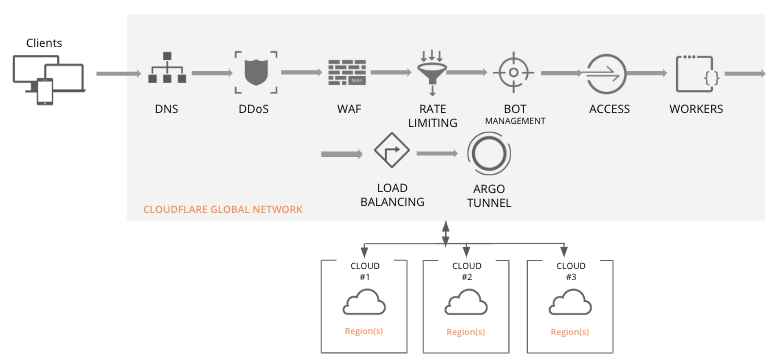
Cloudflare can also function as a FaaS (serverless) provider by hosting and running serverless functions on its distributed global network. Cloudflare Workers is our platform for writing serverless applications using JavaScript.
What is shadow IT?
A multicloud deployment can come about unintentionally, as a result of shadow IT. Shadow IT is when internal teams set up technical systems or use software products without official approval or oversight from the larger organization. A simple example would be if a company's employees use a chat app that is not sanctioned or managed by the company to communicate about business activities.
Shadow IT can find its way into application architecture too. Either as a short cut for getting things done, or out of necessity, employees may incorporate cloud services into a company's technology stack before receiving official approval.
How does Cloudflare help businesses with multicloud management?
Cloudflare enables businesses to manage their cloud deployments' performance and security from a single dashboard. The Cloudflare network stretches all around the globe in 335++ cities to help ensure performance and security for users anywhere in the world.
Learn how a connectivity cloud easily integrates with any type of cloud deployment.
FAQs
What is a multicloud deployment?
A multicloud deployment is the use of several different public clouds from more than one vendor. Rather than relying on a single provider for all hosting, storage, and application needs, an organization spreads its infrastructure across multiple cloud environments.
How does multicloud differ from hybrid cloud?
While both involve multiple environments, hybrid cloud specifically refers to the combination of two or more distinct types of infrastructure, such as a private cloud or on-premises data center mixed with public cloud. Multicloud refers to the use of several different public clouds and does not necessarily imply a private cloud component.
[Image comparing multicloud vs hybrid cloud architecture]What are the main benefits of adopting a multicloud strategy?
Using multiple clouds increases reliability and redundancy. If one vendor experiences an outage, other clouds can keep services running. It also reduces vendor lock-in, making it easier to migrate services because the entire infrastructure is not tied to one provider.
What challenges should businesses expect when managing multiple clouds?
Managing multicloud environments adds complexity, as IT teams must navigate different vendor processes, security protocols, and interfaces. It can also lead to increased latency if services in different clouds need to communicate frequently, and it expands the potential attack surface by integrating more pieces of software and hardware.
How does Cloudflare simplify the management of a multicloud environment?
Cloudflare acts as a unified interface that sits between end users and cloud providers. It allows businesses to manage security and performance across all their cloud environments from a single dashboard, offering tools like multicloud load balancing to distribute traffic and a web application firewall (WAF) to block threats across deployed clouds.